Love this? Save it for later!
Share the inspiration with your friends
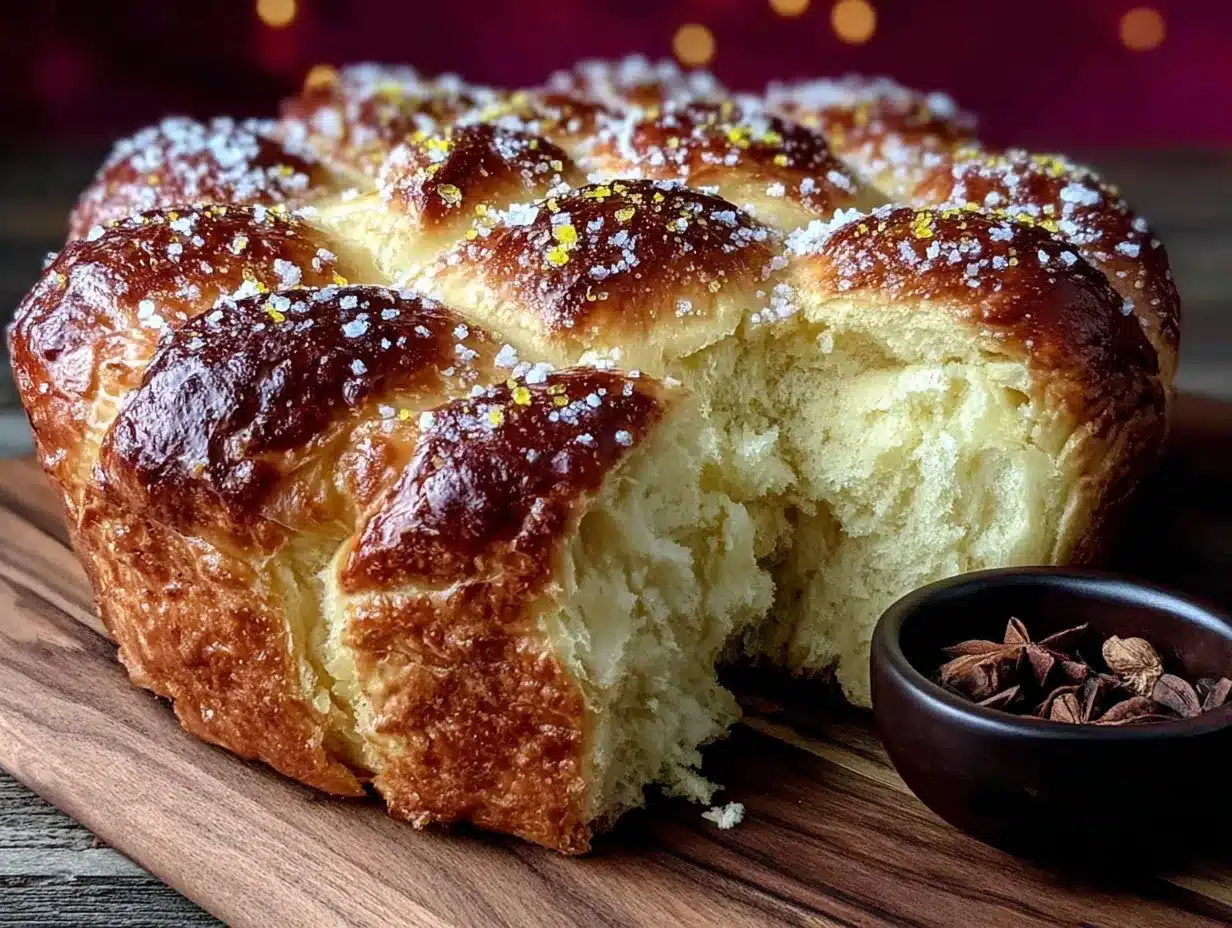
It was 11:47 PM on a random Tuesday in October, and I had that familiar restless energy—the kind that makes you scroll through old photos and then, inevitably, wander into the kitchen. I wasn’t planning to bake. Honestly, I was just looking for a glass of water. But then I saw the bag of anise stars sitting on the counter, bought on a whim at a Mexican grocery store three weeks earlier, and the idea just arrived. I didn’t have the patience for a traditional pan de muerto recipe that called for starter dough and a full day of proofing. But I had butter, eggs, orange zest, and a stubborn need to make something that smelled like the holiday I’d never actually celebrated properly. So I started pulling things out of the fridge, hoping it wouldn’t be a disaster. My kitchen looked like a flour bomb had gone off by midnight, and I’m pretty sure I got orange zest in my hair. But when I pulled that golden, fragrant loaf out of the oven at 1:15 AM, the whole apartment smelled like a Day of the Dead altar—warm, floral, sweet, and somehow nostalgic for a memory I didn’t even have. I tore off a piece while it was still warm, and let me tell you, that first bite made the mess worth it. This fluffy pan de muerto with orange zest and anise has been my go-to ever since, and maybe you’ve been there—wanting to make something meaningful but not having all day to do it. This recipe is for those nights.
Why You’ll Love This Recipe
I’ve tested this recipe more times than I care to admit—through three different ovens, two altitude zones, and one memorable attempt where I forgot the salt entirely. Through it all, this version has emerged as the one I keep coming back to. It’s not just another pan de muerto recipe; it’s the one that actually works on a weeknight.
- Quick & Easy: From start to finish, this comes together in about 2.5 hours—much faster than traditional versions that require overnight rests or complicated starters. Perfect for when you need that aromatic, holiday magic on short notice.
- Simple Ingredients: No specialty bread flour or hard-to-find fats. Butter, eggs, all-purpose flour, and pantry spices. The anise and orange zest do the heavy lifting flavor-wise.
- Perfect for Day of the Dead: Obviously, this is the traditional occasion. But honestly? It’s also incredible for fall brunches, Thanksgiving morning, or just a cozy weekend bake when you want your house to smell incredible.
- Crowd-Pleaser: I’ve brought this to three different gatherings and watched it disappear every single time. Kids love the subtle sweetness, adults appreciate the sophisticated anise-orange combo.
- Unbelievably Fluffy: The texture is the real star here. It’s not dense like some bread-based holiday treats. It’s pillowy, tender, and practically melts on your tongue.
What makes this recipe different from the rest? It’s the technique of blooming the anise in warm milk before adding it to the dough. That little step releases the essential oils in a way that dry spices never achieve. Plus, I use a tangzhong-style milk roux to keep the crumb extra soft for days. This isn’t just another version—it’s the best version I’ve ever made, and I’ve made a lot of them.
This recipe is the kind that makes you close your eyes after the first bite. It’s tradition reimagined—faster, fluffier, but with the same soul-soothing satisfaction. Perfect for honoring the holiday without spending your entire day in the kitchen.
What Ingredients You Will Need
This recipe uses simple, wholesome ingredients to deliver that signature aromatic flavor and pillowy texture. Most of these are pantry staples, which makes this an easy last-minute bake.
For the Tangzhong (Milk Roux)
- 2 tablespoons (20g) bread flour
- 1/4 cup (60ml) whole milk
For the Dough
- 2 1/2 cups (320g) all-purpose flour, plus more for dusting
- 1/4 cup (50g) granulated sugar
- 1 packet (2 1/4 teaspoons) active dry yeast
- 1/2 teaspoon salt
- 1 teaspoon anise seeds, lightly crushed (I use a mortar and pestle for this)
- Zest of 2 medium oranges (about 2 tablespoons)
- 1/2 cup (120ml) whole milk, warm (about 110°F)
- 1 large egg, room temperature
- 1 large egg yolk, room temperature
- 3 tablespoons (42g) unsalted butter, softened to room temperature
- 1 teaspoon vanilla extract
For the Topping
- 2 tablespoons (28g) unsalted butter, melted
- 2 tablespoons granulated sugar
- 1 teaspoon anise seeds (optional, for garnish)
- Orange zest strips, for decoration (optional but pretty)
Ingredient Notes: I recommend using King Arthur Flour for consistent results—their all-purpose flour has a slightly higher protein content that works beautifully for enriched doughs. For the anise, try to find whole seeds rather than pre-ground; the flavor is much more vibrant. I get mine from the bulk spice section at Whole Foods. If you can’t find anise seeds, you can substitute fennel seeds, though the flavor will be a bit more licorice-forward. For the orange zest, use organic oranges if possible since you’re using the peel. The zest is where all the aromatic oils live, and non-organic oranges sometimes have a waxy coating that doesn’t incorporate as well.
Substitution Guidance: Need a dairy-free version? Use oat milk for both the tangzhong and the dough, and substitute vegan butter (I like Miyoko’s) for the regular butter. The texture won’t be quite as tender, but it’s still delicious. For a gluten-free option, I honestly wouldn’t recommend it for this recipe—the structure of enriched bread dough is hard to replicate without gluten. But you could try a 1:1 gluten-free flour blend if you’re adventurous.
Equipment Needed
Nothing too fancy here. You probably already have most of this in your kitchen.
- Stand mixer with dough hook: This makes the kneading process so much easier. I use my KitchenAid Artisan and it handles this dough beautifully. If you don’t have one, you can absolutely knead by hand—it’ll just take about 10-12 minutes of arm work.
- Large mixing bowl: For the tangzhong and for letting the dough rise
- Small saucepan: For making the tangzhong
- Microplane or fine grater: For zesting the oranges. A regular box grater works too, but microplane gives you finer zest that incorporates better.
- Mortar and pestle: For lightly crushing the anise seeds. You can also use the bottom of a heavy skillet if you don’t have one.
- Baking sheet: Line it with parchment paper for easy cleanup
- Pastry brush: For applying the melted butter topping
- Plastic wrap or a clean kitchen towel: For covering the dough while it rises
- Cooling rack: Essential for letting the bread cool evenly so the bottom doesn’t get soggy
Budget-friendly tip: If you don’t have a stand mixer, you can knead this dough by hand. It’s actually kind of therapeutic. Just be prepared for a bit of a workout—enriched doughs are stickier than lean bread doughs. Keep a bench scraper handy for cleaning your hands.
Preparation Method
Let’s get baking! I’ve broken this down into clear steps with all the little details that make the difference between good pan de muerto and amazing pan de muerto.
Step 1: Make the Tangzhong (10 minutes)
In a small saucepan, whisk together the 2 tablespoons of bread flour and 1/4 cup of milk until smooth with no lumps. Place over medium-low heat and cook, stirring constantly with a whisk or spatula, until the mixture thickens into a paste—this usually takes about 2-3 minutes. You’re looking for a texture similar to thick pudding or wallpaper paste (not the most appetizing comparison, I know, but accurate). When you drag your spatula through it, the paste should hold its shape for a second before slowly flowing back together. Remove from heat and let it cool to room temperature while you gather your other ingredients.
Step 2: Bloom the Yeast (5 minutes)
In the bowl of your stand mixer (or a large bowl if kneading by hand), combine the 1/4 cup of warm milk (about 110°F—should feel like warm bath water on your wrist) with 1 tablespoon of the granulated sugar and the packet of active dry yeast. Give it a quick stir and let it sit for 5-10 minutes until it becomes foamy and bubbly. If it doesn’t foam, your yeast might be dead—check the expiration date and try again with fresher yeast. This step is non-negotiable for fluffy bread.
Step 3: Build the Dough (15 minutes)
To the bloomed yeast, add the cooled tangzhong, the remaining sugar, the salt, crushed anise seeds, orange zest, the whole egg, egg yolk, and vanilla extract. Mix on low speed with the paddle attachment (or by hand with a wooden spoon) until roughly combined—about 30 seconds. Switch to the dough hook and add the all-purpose flour, 1/2 cup at a time, mixing on medium-low speed. The dough will look shaggy at first. After about 3 minutes, add the softened butter, one tablespoon at a time, letting each piece incorporate fully before adding the next. This is important—adding the butter too quickly can make the dough greasy and prevent it from rising properly.
Step 4: Knead the Dough (8-10 minutes)
Once all the butter is incorporated, increase the speed to medium and knead for 8-10 minutes. The dough should pull away from the sides of the bowl and become smooth and elastic. It will still be slightly tacky to the touch—that’s fine. Don’t be tempted to add more flour unless it’s truly unmanageable. The tangzhong and butter create a soft, supple dough that’s a joy to work with. To test if it’s kneaded enough, do the windowpane test: tear off a small piece of dough and stretch it gently between your fingers. If it stretches thin enough to see light through without tearing, you’re good.
Step 5: First Rise (1 hour)
Shape the dough into a smooth ball and place it in a lightly greased bowl (I use a drizzle of olive oil). Cover tightly with plastic wrap or a damp kitchen towel and let it rise in a warm, draft-free spot for about 1 hour, or until doubled in size. My oven with the light on works perfectly—it stays around 80°F, which is ideal. If your kitchen is cold, it might take closer to 1 hour 15 minutes.
Step 6: Shape the Loaf (15 minutes)
Punch down the risen dough gently to release the air. Turn it out onto a lightly floured surface. Divide the dough into two pieces: one larger piece (about 2/3 of the dough) for the main loaf, and one smaller piece (about 1/3) for the decorative bone shapes. Shape the larger piece into a round boule by tucking the edges under and rotating it in a circular motion on the counter. Place it on your parchment-lined baking sheet. For the decorations, divide the smaller piece into 4 equal parts. Roll each into a rope about 6 inches long. Place two ropes across the top of the loaf in a cross pattern, and the other two ropes around the sides like a ring. This is the traditional pan de muerto shape. Don’t stress if it’s not perfect—mine never is, and it always looks beautiful baked.
Step 7: Second Rise (45 minutes)
Cover the shaped loaf loosely with plastic wrap and let it rise for another 45 minutes, or until puffy and nearly doubled. It should feel light and airy when you gently poke it.
Step 8: Bake (25-30 minutes)
Preheat your oven to 350°F (175°C) about 15 minutes before the second rise is done. Bake the loaf for 25-30 minutes, until the top is deeply golden brown and the internal temperature reaches 190°F (88°C) on an instant-read thermometer. If the top is browning too quickly (after about 15 minutes), tent loosely with aluminum foil. Your kitchen will smell absolutely incredible at this point—like orange blossoms and warm anise.
Step 9: Add the Topping (5 minutes)
Remove the bread from the oven and let it cool on the baking sheet for 5 minutes. Brush the top generously with the melted butter, then sprinkle with the granulated sugar and optional anise seeds. Let it cool completely on a wire rack before slicing—I know it’s tempting, but the texture sets as it cools. At least 30 minutes of patience, I promise it’s worth it.
Cooking Tips & Techniques
After making this recipe more times than I can count, I’ve learned a few things the hard way. Let me save you some trouble.
Don’t skip the tangzhong. I know it’s an extra step, but it’s the secret to that fluffy, bakery-style texture that lasts for days. The gelatinized flour absorbs more liquid, which means your bread stays moist and tender instead of drying out by the next morning. I learned this the hard way after making a version without it that was practically croutons by day two.
Temperature matters more than you think. If your milk is too hot (above 120°F), it will kill the yeast. If it’s too cold, the yeast won’t activate properly. I use an instant-read thermometer, but if you don’t have one, test it on your wrist—it should feel like a warm bath, not hot. Also, make sure your eggs and butter are truly at room temperature. Cold ingredients will shock the yeast and make the dough take forever to rise. I’ve definitely been impatient and used cold eggs before—the dough rose for nearly 3 hours and still wasn’t doubled. Learn from my mistakes.
Watch your flour. Different brands absorb liquid differently. Start with the lower amount of flour and add more only if the dough feels excessively sticky. It should be tacky but not unmanageable. If you add too much flour, you’ll end up with a dense, dry bread. The dough should feel soft and pillowy, like a baby’s cheek.
Crush the anise seeds gently. You want to release the oils, not turn them into powder. I use a mortar and pestle with a light hand—just a few firm twists. The little flecks of anise throughout the bread are part of the charm. If you grind them too fine, the flavor can become overpowering.
Multitask like a pro. While the dough is doing its first rise, zest your oranges, measure out your other ingredients, and line your baking sheet. During the second rise, preheat your oven and make the melted butter topping. This way, you’re never standing around waiting.
Variations & Adaptations
This recipe is incredibly versatile. Here are a few ways I’ve adapted it over the years.
Orange-Anise with Chocolate Drizzle: After baking and cooling, melt 1/2 cup of dark chocolate chips with 1 tablespoon of coconut oil and drizzle it over the top. The bitterness of the dark chocolate pairs beautifully with the sweet anise and bright orange. I made this version for a friend’s birthday and it was gone in 10 minutes.
Lavender-Honey Pan de Muerto: Replace the orange zest with 1 tablespoon of dried culinary lavender (crushed lightly) and swap the granulated sugar in the topping for 2 tablespoons of honey mixed with the melted butter. The floral notes are subtle and elegant—perfect for a springtime celebration.
Vegan Version: I tested this for a vegan friend and it actually worked surprisingly well. Use oat milk for the tangzhong and dough, substitute the eggs with 2 tablespoons of aquafaba (the liquid from a can of chickpeas) plus 1 tablespoon of cornstarch, and use vegan butter. The texture is slightly less tender, but the flavor is still wonderful. Just note that the rise time might be a bit longer—about 15-20 minutes extra for each rise.
Spiced Version: Add 1/2 teaspoon of cinnamon and 1/4 teaspoon of nutmeg along with the anise seeds. This gives the bread a more traditional fall spice profile that’s amazing for Thanksgiving morning. I made this last November and my family demanded it become a yearly tradition.
Individual Rolls: Instead of one large loaf, divide the dough into 12 equal pieces and shape into balls. Place them in a greased 9×13 baking dish, let rise, and bake for 18-22 minutes. These are perfect for parties or gifting.
Serving & Storage Suggestions
This bread is best served warm, but it’s honestly delicious at any temperature.
Serving: Slice the pan de muerto and serve it alongside a cup of Mexican hot chocolate or café de olla (Mexican spiced coffee). The warm, spiced beverages complement the orange-anise flavors beautifully. For a brunch spread, I love serving it with a dollop of crema or Greek yogurt and a drizzle of honey. It’s also incredible toasted the next day with butter—the anise flavor becomes even more pronounced.
Storage: Store the bread in an airtight container or wrapped tightly in plastic wrap at room temperature for up to 3 days. Do not refrigerate—the cold temperature will dry it out and make it stale faster. If you live in a humid climate, you might want to store it in a paper bag instead to prevent the sugar topping from getting sticky.
Freezing: This bread freezes beautifully. Wrap the completely cooled loaf tightly in plastic wrap, then in aluminum foil, and freeze for up to 3 months. To thaw, leave it at room temperature for 2-3 hours, then warm it in a 300°F oven for 5-10 minutes. The texture will be almost as good as fresh. I always make a double batch and freeze one loaf for later.
Reheating: For that just-baked experience, wrap slices in foil and warm them in a 300°F oven for 5-7 minutes. You can also microwave individual slices for 15 seconds, but the texture won’t be as nice. Toaster ovens work great too—just watch closely so the sugar topping doesn’t burn.
Flavor Development: Honestly, this bread tastes even better on day two. The orange and anise flavors have time to meld and deepen. So if you’re making it for a specific occasion, baking it a day ahead is actually a smart move.
Nutritional Information & Benefits
While pan de muerto is definitely a treat, it does have some redeeming qualities.
| Nutrient | Per Slice (1/12 of loaf) |
|---|---|
| Calories | 195 |
| Total Fat | 7g |
| Saturated Fat | 4g |
| Cholesterol | 45mg |
| Sodium | 115mg |
| Total Carbohydrates | 29g |
| Dietary Fiber | 1g |
| Sugars | 9g |
| Protein | 5g |
Health Benefits: Orange zest is packed with vitamin C and antioxidants. Anise seeds have been used traditionally to aid digestion—which is welcome after a rich meal. The eggs and milk provide protein and calcium. And honestly, there’s something to be said for the mental health benefits of baking something beautiful and sharing it with people you love. That counts for something, right?
Dietary Considerations: This recipe contains gluten, dairy, and eggs. For the vegan version mentioned above, the nutritional values will change slightly (lower fat, slightly higher carbs). This bread is not low-carb or keto-friendly, but it is a wonderful occasional indulgence that fits into a balanced eating pattern.
Conclusion
This fluffy pan de muerto with orange zest and anise has become one of my most-requested recipes, and I honestly think it’s because it captures something special. It’s not just a bread—it’s a memory in the making. The scent of orange and anise filling your kitchen, the satisfaction of shaping that traditional loaf, the joy of pulling apart a warm slice with someone you care about. That’s what makes this recipe worth trying.
I encourage you to make it your own. Add more orange zest if you love citrus. Skip the anise if it’s not your thing. Drizzle it with chocolate or serve it with honey. The best recipes are the ones that adapt to you, not the other way around.
I’d love to hear how yours turns out! Drop a comment below and let me know if you tried any variations, or tag me in your photos on social media. There’s something so special about seeing this bread being made in kitchens around the world. Happy baking, and remember—the best things in life are often the ones you make at 11 PM on a Tuesday, just because you felt like it.
Frequently Asked Questions
Can I make this pan de muerto without a stand mixer?
Absolutely! You can knead the dough by hand. It will take about 10-12 minutes of consistent kneading. The dough will be a bit sticky, so keep a bench scraper handy. The texture might be slightly less uniform, but it will still be delicious.
Why is my dough not rising?
This usually happens for one of three reasons: your yeast is expired (check the date), your milk was too hot and killed the yeast (should be around 110°F), or your kitchen is too cold. Try placing the dough in your oven with just the light on—it creates a warm, draft-free environment that’s perfect for rising.
Can I use dried orange peel instead of fresh zest?
You can, but I really recommend fresh zest for this recipe. The essential oils in fresh orange zest provide a brightness that dried peel just can’t match. If you’re in a pinch, use about 1 tablespoon of dried orange peel and rehydrate it in 1 tablespoon of warm water before adding it to the dough.
How do I get the traditional pan de muerto shape?
The traditional shape involves a round loaf with bone-shaped decorations on top. After shaping the main loaf, roll small pieces of dough into ropes, then place them across the top in a cross pattern and around the sides like a ring. Don’t worry if it’s not perfect—rustic is part of the charm. The bones are meant to represent the deceased, and the round shape represents the circle of life.
Can I freeze this bread?
Yes! It freezes beautifully for up to 3 months. Wrap the completely cooled loaf tightly in plastic wrap, then in aluminum foil. When you’re ready to enjoy it, thaw at room temperature and warm in a 300°F oven for 5-10 minutes. It’s almost as good as fresh.
Pin This Recipe!
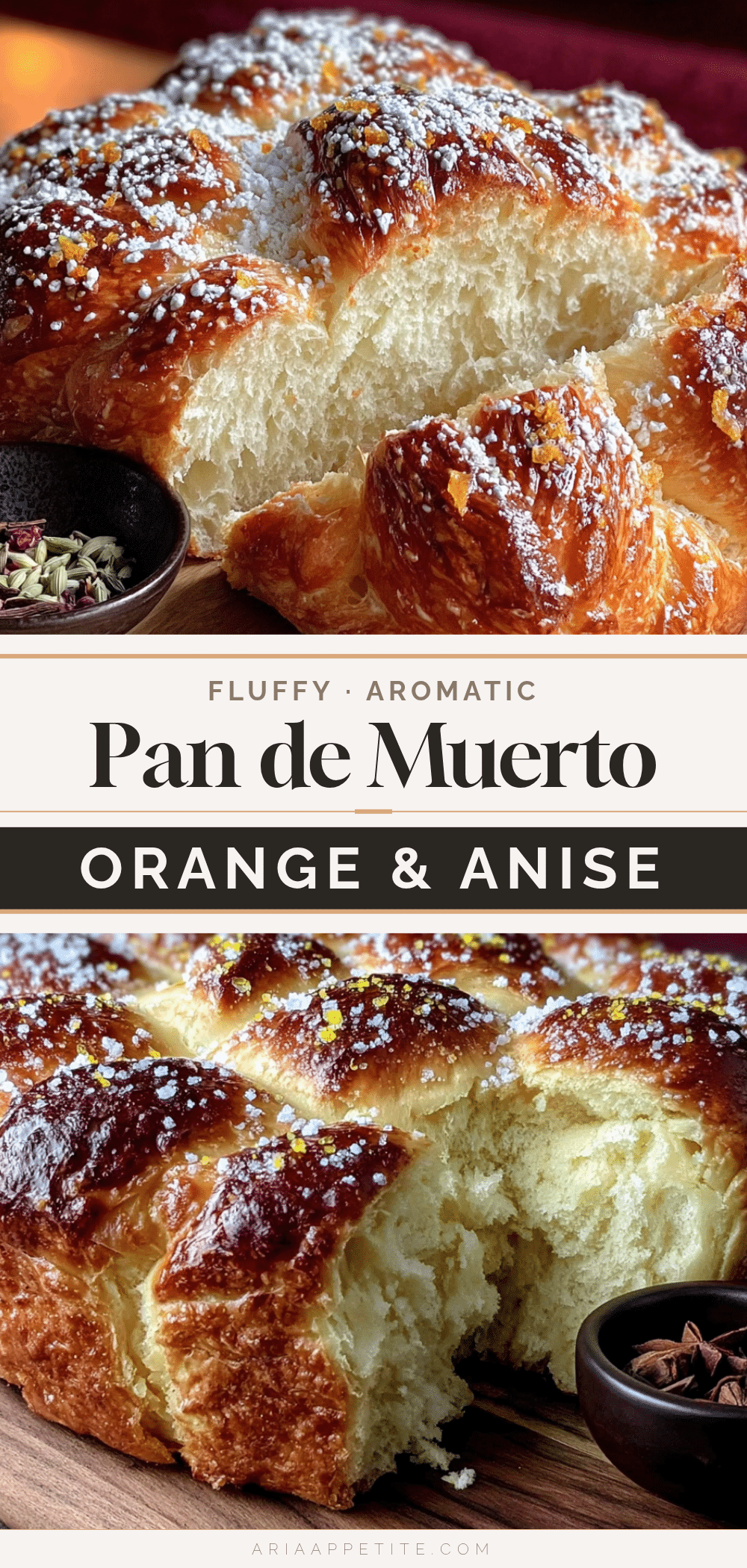
Fluffy Pan de Muerto with Orange Zest & Anise – Easy Recipe
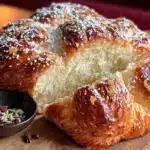
A quick and easy version of the traditional Day of the Dead bread, made fluffy with a tangzhong milk roux and infused with orange zest and anise. Perfect for a weeknight bake, this recipe delivers a pillowy, aromatic loaf in about 2.5 hours.
- Prep Time: 30 minutes
- Cook Time: 30 minutes
- Total Time: 2 hours 30 minutes
- Yield: 12 servings 1x
- Category: Bread
- Cuisine: Mexican
Ingredients
- 2 tablespoons (20g) bread flour
- 1/4 cup (60ml) whole milk
- 2 1/2 cups (320g) all-purpose flour, plus more for dusting
- 1/4 cup (50g) granulated sugar
- 1 packet (2 1/4 teaspoons) active dry yeast
- 1/2 teaspoon salt
- 1 teaspoon anise seeds, lightly crushed
- Zest of 2 medium oranges (about 2 tablespoons)
- 1/2 cup (120ml) whole milk, warm (about 110°F)
- 1 large egg, room temperature
- 1 large egg yolk, room temperature
- 3 tablespoons (42g) unsalted butter, softened to room temperature
- 1 teaspoon vanilla extract
- 2 tablespoons (28g) unsalted butter, melted
- 2 tablespoons granulated sugar
- 1 teaspoon anise seeds (optional, for garnish)
- Orange zest strips, for decoration (optional but pretty)
Instructions
- Make the Tangzhong: In a small saucepan, whisk together 2 tablespoons bread flour and 1/4 cup milk until smooth. Cook over medium-low heat, stirring constantly, until thickened into a paste (about 2-3 minutes). Remove from heat and let cool to room temperature.
- Bloom the Yeast: In the bowl of a stand mixer, combine 1/4 cup warm milk (110°F), 1 tablespoon of the sugar, and the yeast. Stir and let sit for 5-10 minutes until foamy.
- Build the Dough: To the bloomed yeast, add the cooled tangzhong, remaining sugar, salt, crushed anise seeds, orange zest, whole egg, egg yolk, and vanilla extract. Mix on low speed until combined. Switch to dough hook and add all-purpose flour, 1/2 cup at a time, mixing on medium-low. After 3 minutes, add softened butter, 1 tablespoon at a time, incorporating fully before adding the next.
- Knead the Dough: Increase speed to medium and knead for 8-10 minutes until dough is smooth and elastic. It should pass the windowpane test.
- First Rise: Shape dough into a ball and place in a lightly greased bowl. Cover and let rise in a warm place for about 1 hour, until doubled in size.
- Shape the Loaf: Punch down dough. Divide into two pieces: 2/3 for the main loaf, 1/3 for decorations. Shape the larger piece into a round boule and place on a parchment-lined baking sheet. Divide the smaller piece into 4 equal parts, roll into 6-inch ropes, and place two across the top in a cross pattern and two around the sides like a ring.
- Second Rise: Cover shaped loaf loosely and let rise for 45 minutes, until puffy and nearly doubled.
- Bake: Preheat oven to 350°F (175°C). Bake for 25-30 minutes, until golden brown and internal temperature reaches 190°F (88°C). Tent with foil if browning too quickly.
- Add Topping: Remove from oven and let cool on baking sheet for 5 minutes. Brush with melted butter, sprinkle with sugar and optional anise seeds. Cool completely on a wire rack before slicing.
Notes
Don’t skip the tangzhong—it keeps the bread fluffy for days. Ensure milk is at 110°F for yeast activation. Use room temperature eggs and butter. Crush anise seeds gently to release oils without turning to powder. The bread tastes even better on day two as flavors meld.
Nutrition
- Serving Size: 1 slice (1/12 of loa
- Calories: 195
- Sugar: 9
- Sodium: 115
- Fat: 7
- Saturated Fat: 4
- Carbohydrates: 29
- Fiber: 1
- Protein: 5
Keywords: pan de muerto, Day of the Dead bread, orange zest, anise, fluffy bread, Mexican bread, holiday bread